
A facility manager in Dubai once told us his HVAC had been “making a funny noise for about six months” before it finally seized. The compressor replacement cost more than two years of scheduled maintenance would have. The noise was the sign. He just didn’t know what it meant.
HVAC systems rarely fail without warning. They send signals; subtle at first, then increasingly urgent , that something needs attention. Knowing how to read those signals is the difference between a scheduled service call and an emergency breakdown in the middle of peak summer.
This guide walks you through the most critical signs your HVAC system needs servicing, what causes each problem, and what to do about it, whether you manage a residential property, a commercial building, or an industrial facility across the UAE.
Related Reading: Preventive Maintenance for HVAC Systems: When, Why, and How | HVAC Services by Foster International
Why Early Detection Matters More in the UAE
According to the U.S. Department of Energy, poor HVAC maintenance can increase energy consumption by 5–20% annually. In the Gulf region, where air conditioning can account for 60–70% of total electricity consumption in commercial buildings, that gap translates directly into significant operating cost increases.
Beyond the bills, the harsh UAE environment accelerates system wear. Sand and fine dust clog filters rapidly, intense solar radiation stresses outdoor units, and high ambient humidity creates ideal conditions for microbial growth inside ductwork. This is why HVAC systems in this region need more frequent attention than the global average,and why the signs below should never be dismissed as “minor issues.”
1. Weak or Inconsistent Airflow From Vents
One of the earliest and most noticeable signs of an HVAC problem is reduced airflow from your vents. If some rooms feel stuffy while others stay cool, or if the air pressure from your registers has noticeably weakened, the system is struggling.
Common causes include:
- Clogged or overloaded air filters (especially common in dusty UAE environments)
- Blocked or leaking ductwork
- A failing blower motor or fan
- Dirty evaporator or condenser coils restricting heat exchange
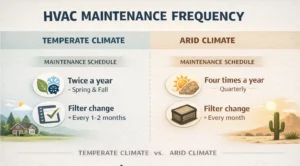
In commercial buildings, uneven airflow is also one of the top causes of occupant comfort complaints, which affect both productivity and tenant retention. Our guide on preventive HVAC maintenance covers how regular filter changes and coil cleaning directly prevent this from developing.
What to do: Start with a filter inspection and replacement. If airflow issues persist after that, call a qualified HVAC technician to assess the blower motor and ductwork for leaks or blockages.
2. Strange or Unusual Noises
A healthy HVAC system produces a low, consistent hum during operation. Any deviation from that grinding, banging, squealing, rattling, or clicking is the system telling you something is mechanically wrong.
| Sound | Likely Cause |
| Grinding | Worn motor bearings or debris in the unit |
| Squealing | Slipping or worn fan belt |
| Banging/Clanking | Loose or broken internal component |
| Clicking (on/off cycles) | Relay or electrical control fault |
| Rattling | Loose panels or debris near outdoor unit |
These sounds rarely resolve on their own. Left unaddressed, a worn bearing becomes a seized motor, and a slipping belt becomes a complete blower failure, at a far higher repair cost. As our HVAC replacement vs. repair guide notes, early mechanical intervention is almost always cheaper than waiting for a cascade failure.
What to do: Don’t dismiss unusual sounds as “normal aging.” Schedule a diagnostic inspection. Early mechanical fixes cost a fraction of emergency motor or compressor replacements.
3. Unpleasant or Unusual Odors
Your HVAC should circulate clean, odourless air. If you’re noticing smells coming from your vents, each type of odour points to a specific problem:
- Musty or mouldy smell: Mould or mildew growth inside the ductwork, drain pan, or evaporator coil, a common issue in humid UAE conditions
- Burning or electrical smell: Overheating motor windings, failing capacitor, or electrical short
- Rotten egg or sulphurous smell: Gas leak near the air handler (requires immediate evacuation and emergency service)
- Chemical or sweet smell: Refrigerant leak, both an environmental concern and a sign your system is losing cooling capacity
The EPA’s indoor air quality guidelines identify HVAC systems as a primary distribution channel for indoor air pollutants. Mould in particular poses serious respiratory health risks. Our blog on improving indoor air quality explores the direct connection between HVAC condition and occupant health.
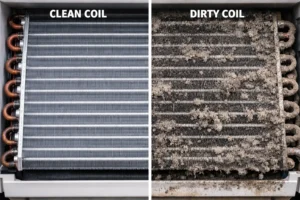
What to do: Musty smells warrant a professional duct inspection and drain pan cleaning. Burning smells require immediate shutdown and electrical inspection. A refrigerant smell means the system needs leak detection and recharging only by a certified technician.
4. Rising Energy Bills Without a Change in Usage
If your electricity bills are climbing month over month with no change in occupancy, operating hours, or tariff rates, your HVAC system is the most likely culprit.
This happens because a degrading system has to work harder and longer to achieve the same result. Dirty coils reduce heat transfer efficiency. Low refrigerant forces the compressor to run extended cycles. A clogged filter restricts airflow and makes the whole system labour more intensely. All of this shows up on your utility statement before it shows up as a breakdown.
In commercial facilities across the UAE, this efficiency gap can be substantial. Even a 10% increase in HVAC energy consumption in a mid-sized office building represents thousands of dirhams per year in unnecessary costs. The U.S. Department of Energy confirms that proper maintenance is essential for efficient HVAC operation and the financial case is just as clear in the Gulf region.
What to do: Compare your current utility bills against the same months in previous years. A spike of 10–15% or more without a corresponding change in usage strongly suggests an HVAC efficiency problem. Schedule a professional system inspection and ask about energy consumption benchmarking.
5. The System Is Short-Cycling
Short-cycling is when your HVAC system turns on and off in rapid, incomplete cycles rather than running through a full cooling or heating cycle. It’s one of the more damaging operational patterns a system can develop.
Each startup cycle places the highest mechanical and electrical stress on the compressor. Frequent short-cycling accelerates wear on this critical and expensive component, while also failing to properly dehumidify or condition the space.
Common causes:
- Oversized or undersized equipment for the space
- Low refrigerant pressure
- Faulty thermostat or temperature sensor
- Dirty condenser coils causing system overheating and automatic shutdown
In extreme-heat environments like the UAE, short-cycling is particularly common during peak summer when outdoor temperatures push systems to operate near their design limits. An undersized system that handled moderate conditions adequately may short-cycle when ambient temperatures exceed 45°C.
What to do: Have a technician run a full system diagnostic including refrigerant pressure tests, thermostat calibration, and a capacity assessment to ensure the unit is correctly sized for the load.
6. Water Leaks or Moisture Around the Unit
Some condensation around an air conditioning unit is normal. Puddles, persistent dripping, or moisture damage around the indoor unit or air handler is not.
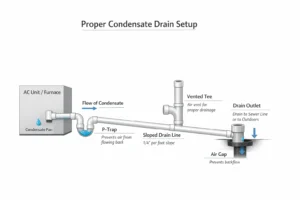
The most common cause is a blocked condensate drain line. In UAE conditions, algae and mould thrive in drain pans and condensate lines due to the warm, humid environment inside cooling equipment. A blocked line causes water to overflow the drain pan, potentially damaging ceilings, walls, insulation, and electrical components, and creating conditions for mould growth.
A more serious cause is refrigerant leakage, which can present as ice formation on coils (which then melts and pools). This requires immediate professional attention.
For facility managers: Our technical resource on where to run AC condensate drain lines provides guidance on correct drain routing to prevent blockage-related overflows.
What to do: Inspect drain pans and condensate lines quarterly. If water leakage is active, shut off the system to prevent water damage and call a technician. Do not assume a minor drip will self-resolve.
7. Inconsistent Temperatures Across Zones or Rooms
If one part of your building is consistently warmer or cooler than the thermostat setpoint, or different areas have dramatically different temperatures, the system is no longer performing to design specification.
In commercial properties, this is often a zoning or ductwork issue: leaking ducts waste conditioned air before it reaches the intended zones. In residential settings, it may indicate an ageing system that has lost the capacity to distribute conditioned air evenly, or a thermostat sensor that is no longer accurately reading ambient temperature.
A thermostat inaccuracy of just 2–3°F can cause the system to over-run, increasing energy costs by up to 10% while still failing to deliver the setpoint temperature.
Our blog on types of HVAC systems covers how different system configurations handle zoning requirements useful context if you’re evaluating whether your current setup is appropriate for your building’s layout.
What to do: Check for obvious blocked vents first. If the issue is building-wide, commission a professional duct inspection and airflow balancing service. For older systems, have the thermostat calibrated or replaced.
8. The System Is Running Constantly Without Reaching Setpoint
An HVAC system that runs non-stop without actually reaching the programmed temperature is a system in distress. This “endless cycle” symptom points to a system that has lost enough efficiency that it simply cannot keep up with the thermal load, even when conditions haven’t changed.
This can be caused by dirty condenser coils that prevent adequate heat rejection, low refrigerant charge, a failing compressor, or a refrigerant that is being phased out and no longer widely available. The last point is increasingly relevant in the UAE as older refrigerant types are being phased out under international environmental agreements, making servicing and recharging progressively more expensive and complicated.
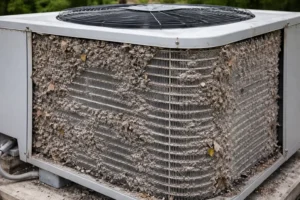
What to do: If the system is running continuously, it is working as hard as it physically can and still falling short. This requires professional assessment. Depending on the system’s age and refrigerant type, this may be a strong signal to evaluate replacement rather than continued repair.
9. Poor Indoor Air Quality: Excess Dust, Humidity, or Stuffiness
Your HVAC system does far more than regulate temperature. It filters particulates, controls humidity, and continuously circulates and refreshes indoor air. When it starts failing at these secondary functions, occupants often notice before any temperature problem becomes apparent.
Warning signs include:
- Visible dust accumulating rapidly on surfaces near vents
- Air that feels stuffy, heavy, or lacking freshness
- Increased allergy symptoms or respiratory complaints among occupants
- Visible mould spots near vents or air handlers
- Humidity that feels noticeably higher than usual indoors
In commercial settings, offices, hotels, healthcare facilities, retail, poor indoor air quality has measurable impacts on productivity, guest experience, and (in the case of healthcare) regulatory compliance. The EPA’s indoor air quality research consistently identifies HVAC maintenance quality as a primary determinant of indoor air health.
What to do: Schedule a duct inspection, drain pan cleaning, and filter replacement. If humidity control is the issue, have the dehumidification components professionally assessed. Our detailed guide on improving indoor air quality through HVAC covers practical steps for both commercial and residential properties.
10. The System Is Older Than 10–12 Years With No Service History
This one isn’t a sound, smell, or symptom, it’s a timeline. Commercial HVAC systems are designed for a 15–20 year lifespan with proper maintenance. Residential units typically perform optimally for 10–15 years. But a system that has not been regularly serviced degrades significantly faster.
In the UAE’s climate, where systems operate far more intensely than in temperate regions, a 10-year-old system that has been irregularly maintained is genuinely at risk of failure, particularly heading into the summer months.
If you don’t have documented service records for your HVAC system, the honest answer is: you don’t know its actual condition. A professional inspection can establish a baseline and give you a clear picture of remaining useful life and upcoming maintenance priorities. Setting up an HVAC annual maintenance contract is the most reliable way to ensure your system stays documented, serviced, and protected going forward.
Quick-Reference: Servicing Signs and What They Indicate
| Warning Sign | Urgency | Most Likely Cause |
| Weak airflow | Medium | Dirty filter, blocked ducts, failing blower |
| Strange noises | Medium–High | Worn bearings, loose components, belt failure |
| Unusual odours | High | Mould, electrical fault, or refrigerant leak |
| Rising energy bills | Medium | Dirty coils, low refrigerant, aged components |
| Short-cycling | High | Wrong sizing, refrigerant issue, sensor fault |
| Water leaks | High | Blocked drain line or refrigerant leak |
| Inconsistent temperatures | Medium | Duct leaks, sensor fault, insufficient capacity |
| Constant running | High | Dirty coils, low refrigerant, failing compressor |
| Poor air quality | Medium | Dirty filters, mould in ducts, failed dehumidification |
| Age + no service history | Varies | Accumulated wear — requires professional baseline assessment |
When Servicing Isn’t Enough: Knowing When to Replace
Not every HVAC problem is a servicing problem. There comes a point where continued repair investment is no longer financially rational, particularly when repair costs approach 50% of replacement cost, the system uses a refrigerant being phased out, or the unit is over 12–15 years old with persistent performance issues.
For a detailed framework on making this decision, read our guide: Signs Your Commercial HVAC System Needs Replacement (Not Just Repair). It walks through the financial calculation, efficiency gap analysis, and the specific conditions that favour replacement over repair ,particularly relevant for commercial building managers in the UAE.
For businesses that need to maintain operations during a system transition, Foster International offers HVAC rental solutions to bridge the gap during equipment replacement.
How Foster International Supports HVAC Servicing in the UAE
As one of the UAE’s trusted HVAC service providers, Foster International brings decades of regional experience to both commercial and residential HVAC maintenance. Our technical team understands the specific demands of operating HVAC systems in extreme heat, high dust environments, and the regulatory landscape of the Gulf region.
Our services span the full maintenance lifecycle:
- Preventive maintenance programs and HVAC annual maintenance contracts
- Supply of genuine HVAC spare parts for rapid repair turnaround
- Full HVAC equipment solutions for system upgrades and replacements
- Rental HVAC solutions for temporary or transitional cooling needs
If your system is showing any of the signs above, the most cost-effective step you can take today is to schedule a professional inspection, before a manageable service issue becomes an emergency breakdown at the worst possible time.
Contact Foster International for an HVAC assessment →
 Previous Post
