

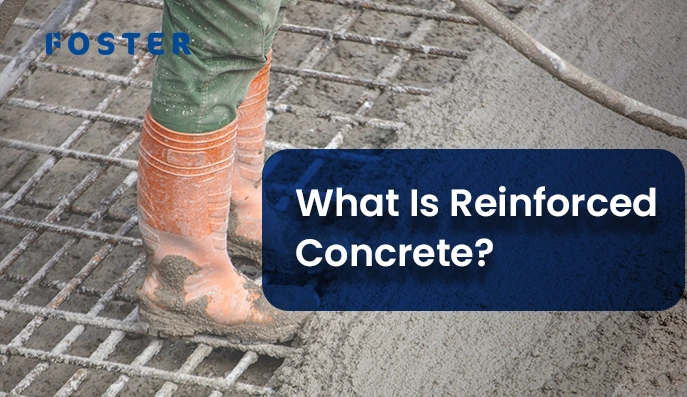
Reinforced Concrete is one of the most revolutionary materials in the construction industry, bringing about a paradigm shift in the manner in which we design and develop infrastructure across the world. This composite material leverages the compressive strength of concrete and, coupled with the tensile strength qualities of steel, in the form of steel bars {rebar} or meshes, enables the development of structures that are strong and resilient. The key insight here is that concrete is strong in compression but weak in tension. By incorporating steel reinforcement in concrete, one is able to create a composite structure in which the strengths and weaknesses of both materials are utilized as a strength. Today, reinforced concrete is at the heart of many structures, including high-rise buildings, large bridges, residential foundation structures, and complicated basement structures.
What Is Reinforced Concrete?
Reinforced Concrete (RC), a highly advanced composite material, was made possible by embedding steel reinforcement inside a concrete cast. This enabled both components to complement each other perfectly, so that concrete supports compressive stresses, and steel supports tension. This invention was first developed by French gardener Joseph Monier in the mid-19th century, which he initially used for creating planters for gardening, realizing its immense possibilities for construction only later.
The key to understanding reinforced concrete lies in the compatibility of the materials. Concrete is very strong in compression, meaning it resists the force of being pushed or pressed, but it is very weak in tension, or the force of being pulled, and tends to fracture easily. Steel, on the other hand, is very strong in tension and is quite ductile.
How Reinforcement Transforms Structural Performance
The term “reinforced” refers specifically to the enhancement of concrete’s structural capacity through embedded steel. This reinforcement doesn’t merely add strength; it fundamentally changes how the material behaves under load. In a reinforced concrete beam subjected to bending, for instance, the bottom portion experiences tension while the top undergoes compression. The concrete naturally handles compression, while strategically placed steel rebar in the tension zone prevents cracking and provides the necessary tensile resistance. This collaborative action enables reinforced concrete to span greater distances, support heavier loads, and maintain structural integrity under diverse conditions that would cause plain concrete to fail catastrophically.
Key Components of Reinforced Concrete
A comprehension of reinforced concrete begins with awareness of its constituent parts, all of which are crucial to its overall functioning:
Concrete Matrix constitutes the main body of the material, which has cement as the binder, aggregates (sand, gravel, too, as a source of strength), as well as water that triggers the chemical reaction that turns the mixture hard. The amount of each component that goes into making the material determines the strength, workability, and durability characteristics.
Steel Reinforcement can be of several types, with deformed steel bars, also known as rebar, with elevations on the surface to promote mechanical anchorage, welded wire mesh for slabs and roads, as well as prefabricated steel cages for columns being some of the most popular ones. The steel reinforcement is placed as per design to resist tensile forces.
The Relationship between Concrete and Steel is perhaps the most crucial function in the relationship between concrete and steel. It is essential for the force transfer between the two materials to be successful. The mechanism of mechanical interlock between the concrete and the steel bars ensures that both materials behave in a manner similar to an elastic body because of their similar co-efficient values to temperatures. Additionally, they both share the same expansion rates.
For architectural and civil engineering projects requiring specialized reinforcement solutions, Foster International’s Architecture and Civil Engineering services provide expert guidance on material selection and structural design optimization.
Main Advantages of Reinforced Concrete
Strength & Load Capacity
Reinforced concrete excels at handling both tensile and compressive stresses simultaneously, making it suitable for virtually any structural application. The material can be engineered to achieve specific strength characteristics by adjusting concrete mix design and reinforcement configuration, offering engineers tremendous flexibility in structural design.
Durability & Longevity
If it is well designed and built, a reinforced concrete structure may last for more than 100 years. Reinforced concrete is highly resistant to weathering by rain or snow or changes in temperatures. Moreover, concrete has an alkaline nature that protects steel from corrosion when it is embedded in it.
Versatility & Design Flexibility
As a fresh material, concrete can be molded into any desired form by means of formwork, so that even where architectural projects involve complicated geometric shapes, architects and engineers can easily create structures in reinforced concrete. Such structures, as already stated, can be constructed in any form wanted.
Foster International’s structural engineering expertise helps clients leverage reinforced concrete’s design flexibility to achieve both structural integrity and architectural vision.
Fire & Environmental Resistance
Reinforced concrete offers outstanding fire resistance, withstanding high temperatures for 2-6 hours and providing critical time for evacuation. The material also demonstrates superior resistance to wind loading, seismic forces, and blast effects, making it the preferred choice for buildings in challenging environmental conditions.
Economical in the Long Run
While initial construction costs may be higher than some alternatives, reinforced concrete delivers exceptional lifecycle value. Its durability minimizes maintenance requirements over decades, reducing long-term ownership costs. The material’s fire resistance can lower insurance premiums, while its thermal mass contributes to energy-efficient buildings.
Common Applications of Reinforced Concrete
Reinforced concrete’s versatility enables its use across virtually all construction sectors:
Buildings and Skyscrapers utilize reinforced concrete for structural frames, floor systems, shear walls, and cores. The material’s compressive strength supports tall structures while its formability accommodates complex architectural geometries. From residential apartments to commercial office towers, reinforced concrete provides the structural backbone for modern urban development.Learn more about modern construction techniques used in major infrastructure projects.
Bridges, Flyovers, and Highways rely heavily on reinforced concrete for girders, decks, piers, and abutments. The material’s durability in harsh environmental conditions, combined with its ability to span significant distances, makes it ideal for transportation infrastructure. Reinforced concrete bridges serve as critical components of modern highway systems worldwide.Understanding bridge bearing systems is crucial for proper load transfer in these structures.
Water Tanks, Pipelines, and Marine Structures benefit from concrete’s impermeability and chemical resistance. Water treatment facilities, storage reservoirs, sewage systems, and coastal protection structures all employ reinforced concrete due to its ability to withstand constant water exposure and resist corrosion from chlorides and other aggressive substances found in marine environments.
Foundations and Retaining Walls use reinforced concrete to transfer building loads to the ground and resist lateral earth pressures. Spread footings, pile caps, basement walls, and earth-retaining structures all depend on reinforced concrete’s strength and durability to provide stable, long-lasting support for superstructures above.
Precast Structural Components manufactured in controlled factory environments include beams, columns, wall panels, floor slabs, and specialized elements like bridge girders. Precasting offers quality control advantages while accelerating on-site construction schedules. These components are widely used in industrial, commercial, and infrastructure projects.Modern facilities often integrate HVAC systems within structural design to optimize building performance.
Explore Foster International’s completed projects to see how reinforced concrete solutions have been successfully implemented across diverse civil engineering applications.
Limitations & Challenges
Despite its many advantages, reinforced concrete presents certain limitations:
Heavy Weight creates substantial dead loads that must be accounted for in foundation design and can increase transportation costs for precast elements.
Longer Curing Time means reinforced concrete requires days to weeks to achieve design strength, which can impact construction schedules compared to steel frame construction.
Quality Control Requirements are stringent—formwork placement, concrete consolidation, reinforcement positioning, and proper curing all require careful attention. Poor quality control at any stage can compromise structural performance.
Environmental Considerations include significant carbon dioxide emissions from cement production. The industry continues addressing these concerns through sustainable concrete alternatives and supplementary cementitious materials.
Conclusion
Reinforced concrete remains one of the most important and widely used building materials in modern construction, and for good reason. Its unique combination of strength, durability, versatility, and economic value makes it irreplaceable for infrastructure development worldwide. The material’s ability to be formed into any shape while providing excellent load-carrying capacity, fire resistance, and longevity ensures its continued dominance in construction for the foreseeable future. As engineering practices evolve and sustainability becomes increasingly critical, reinforced concrete continues to adapt through innovations in material science and construction techniques.
Whether you’re planning a high-rise building, bridge infrastructure, industrial facility, or residential development, reinforced concrete offers proven performance backed by decades of successful application. Learn how Foster International’s architecture and civil engineering team can help you implement reinforced concrete solutions optimized for your specific project requirements. Our expertise spans structural design, material specification, and construction planning to ensure your reinforced concrete structures deliver maximum performance, durability, and value.
Contact our engineering services team today to discuss how reinforced concrete can meet your project’s structural and architectural objectives.
 Previous Post
