

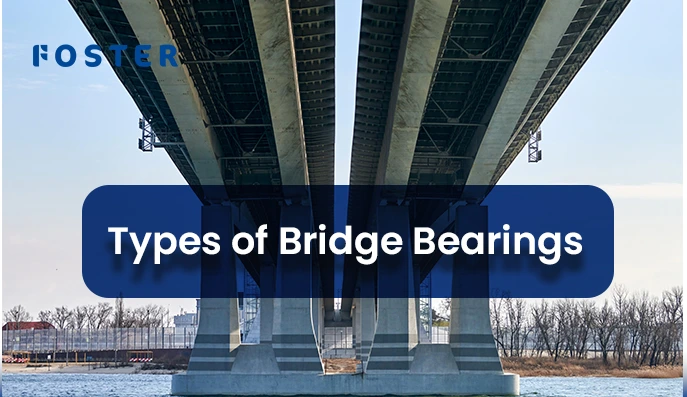
Bridge bearings are critical structural components that connect a bridge’s superstructure to its substructure. These mechanical devices serve dual purposes: transferring loads from the bridge deck to the foundation while accommodating various movements caused by traffic, temperature changes, wind, seismic activity, and structural deformations.
Understanding the different types of bridge bearings helps engineers, contractors, and infrastructure managers select the most appropriate solution for their specific project requirements.
Understanding Bridge Bearing Categories
As we mentioned in our earlier article on bridge bearings, bridge bearings serve two primary functions: transferring loads from the deck to the supporting structure while allowing controlled movement. Based on these functions, bearings fall into two main categories:
Fixed Bearings
Fixed bearings transfer both vertical loads and horizontal forces in all directions while allowing only rotational movement. They provide a stable reference point for the bridge structure, anchoring it at specific locations.
Expansion Bearings (Guided and Free-Sliding)
Expansion bearings accommodate translational movements in addition to rotation. These are essential for managing thermal expansion, contraction, and other structural movements throughout the bridge’s lifecycle.
Common Types of Bridge Bearings
1. Elastomeric Bearings
Elastomeric bearings are manufactured from natural or synthetic rubber materials and represent one of the most widely used bearing types in modern bridge construction.
Types of Elastomeric Bearings:
- Plain elastomeric bearing pads (unreinforced)
- Steel reinforced elastomeric bearings (laminated)
- Fiber reinforced elastomeric bearings
Key Features:
- Accommodate movement through elastomer deformation
- Support both translational and rotational movements
- Cost-effective solution requiring minimal maintenance
- Suitable for moderate load applications
- Prevent lateral bulging through proper reinforcement
Applications: Short to medium span bridges, highway overpasses, pedestrian bridges
2. Pot Bearings (Pot PTFE Bearings)
Pot bearings consist of a metal piston supported by an unreinforced elastomer disc confined within a cylindrical steel pot. The elastomeric pad is compressed inside the pot, creating high vertical stiffness while maintaining low rotational resistance.
Types of Pot Bearings:
- Fixed pot bearings (no horizontal movement)
- Sliding pot bearings (free movement in all directions)
- Guided pot bearings (controlled movement along one axis)
Key Features:
- Excellent for high vertical load capacity
- Low friction sliding with PTFE (Teflon) interface
- Accommodates rotation about any horizontal axis
- Durable and long-lasting performance
Applications: Highway bridges, railway bridges, heavy load structures
3. Spherical Bearings
Spherical bearings feature matching concave and convex spherical steel plates with a low-friction sliding interface, enabling rotation through curved sliding motion.
Types of Spherical Bearings:
- Fixed spherical bearings
- Sliding spherical bearings
- Guided spherical bearings
Key Features:
- Superior rotational capacity compared to pot bearings
- Handles extremely high vertical loads
- Excellent for large bridges with significant movements
- Low maintenance requirements
- High durability and corrosion resistance
Applications: Long-span bridges, seismic zones, major infrastructure projects
4. Roller Bearings
Roller bearings use cylindrical rollers positioned between two metal plates to facilitate horizontal movement through rolling action.
Types:
- Single roller bearings
- Multiple roller bearings
Key Features:
- Simple mechanical design
- Accommodate large translational movements
- Limited weight capacity (especially single roller types)
- Require regular inspection and maintenance
- Susceptible to corrosion and environmental deterioration
Applications: Steel bridges, shorter span structures with predictable movements
5. Rocker and Pin Bearings
Rocker bearings combine a curved bottom surface for translational movement with a pin connection at the top for rotational movement.
Key Features:
- Suitable for steel bridge structures
- Accommodate both translation and rotation
- Effective when bridge movements are well-defined
- Require regular maintenance due to corrosion susceptibility
- Traditional design used for decades
Applications: Steel truss bridges, historical bridge retrofits
6. Disk Bearings
Disk bearings provide rotational freedom through flat circular PTFE sliding surfaces while transferring vertical loads through the disk interface.
Key Features:
- Compact design profile
- Suitable for moderate loads
- Simple installation process
- Cost-effective for specific applications
Applications: Buildings, short-span bridges, modular construction
7. Guide and Restraint Bearings
These specialized bearings are designed to transfer large horizontal forces while controlling the direction of movement.
Key Features:
- High horizontal load capacity
- Restrict movement to predetermined directions
- Often combined with free-sliding bearings
- Essential for seismic and wind resistance
Applications: Bridges in seismic zones, structures requiring lateral restraint
The Relationship Between Bearings and Expansion Joints
While bridge bearings and expansion joints are distinct components, they work together to manage bridge movement and maintain structural integrity. Bearings handle the load transfer and controlled movement at support points, while expansion joints accommodate movement at the deck level, preventing damage from thermal expansion and contraction.
Selecting the Right Bridge Bearing
Choosing the appropriate bearing type depends on several project-specific factors:
Load Requirements:
- Vertical load magnitude (dead and live loads)
- Horizontal force demands (braking, seismic, wind)
- Moment transfer requirements
Movement Considerations:
- Expected translational displacement
- Rotational requirements
- Frequency and magnitude of movement cycles
Environmental Factors:
- Temperature extremes in the Middle East
- Seismic activity considerations
- Exposure to marine or industrial environments
- UV radiation and weathering
Project Constraints:
- Budget availability
- Maintenance access and frequency
- Construction methodology
- Lifespan requirements
Standards Compliance:
- International design standards (EN 1337, AASHTO, BS 5400)
- Regional specifications
- Quality certifications (CE marking)
Foster International’s Bridge Bearing Solutions
Foster International has extensive experience in supplying and supervising spherical bearing installations for major infrastructure projects. Our civil engineering division works with leading manufacturers like D.S. TechStar, Inc. to provide comprehensive bearing solutions across the GCC region.
Our bridge bearing services include:
Supply and Procurement: We source high-quality bearings from certified manufacturers, ensuring compliance with international standards and project specifications.
Technical Consultation: Our engineering team assists in bearing selection, design review, and specification development to ensure optimal performance for your specific application.
Installation Supervision: We provide expert supervision during bearing installation to guarantee proper placement, alignment, and initial performance.
Project Experience: Foster International has successfully delivered bearing solutions for major projects including:
- Al Shindagha Corridor Project (Spherical Bearings for RTA)
- DEWA Metro Link Bridge Project
- Multiple infrastructure developments across the UAE and GCC
Maintenance and Longevity
Different bearing types have varying maintenance requirements:
- Elastomeric Bearings: Minimal maintenance required; periodic visual inspections to check for damage, displacement, or deterioration
- Pot and Spherical Bearings: Regular inspections of sliding surfaces, PTFE condition, and proper movement; cleaning to remove debris
- All Bearing Types: Monitor for signs of corrosion, proper alignment, and expected movement patterns
Regular inspection and maintenance extend bearing life and ensure continued structural safety.
Conclusion
Understanding the types of bridge bearings and their specific applications is crucial for successful infrastructure projects. Whether your project requires economical elastomeric bearings for a standard overpass, robust pot bearings for heavy loads, or sophisticated spherical bearings for complex geometries, selecting the right solution ensures long-term structural performance and safety.
At Foster International, we combine decades of experience in civil engineering with partnerships with world-class manufacturers to deliver bearing solutions that meet the demanding requirements of Middle East infrastructure projects. From initial consultation through installation and beyond, our team is committed to supporting your project’s success.
For expert guidance on bridge bearing selection and supply for your next infrastructure project in the UAE or across the GCC, contact Foster International today.
 Previous Post
